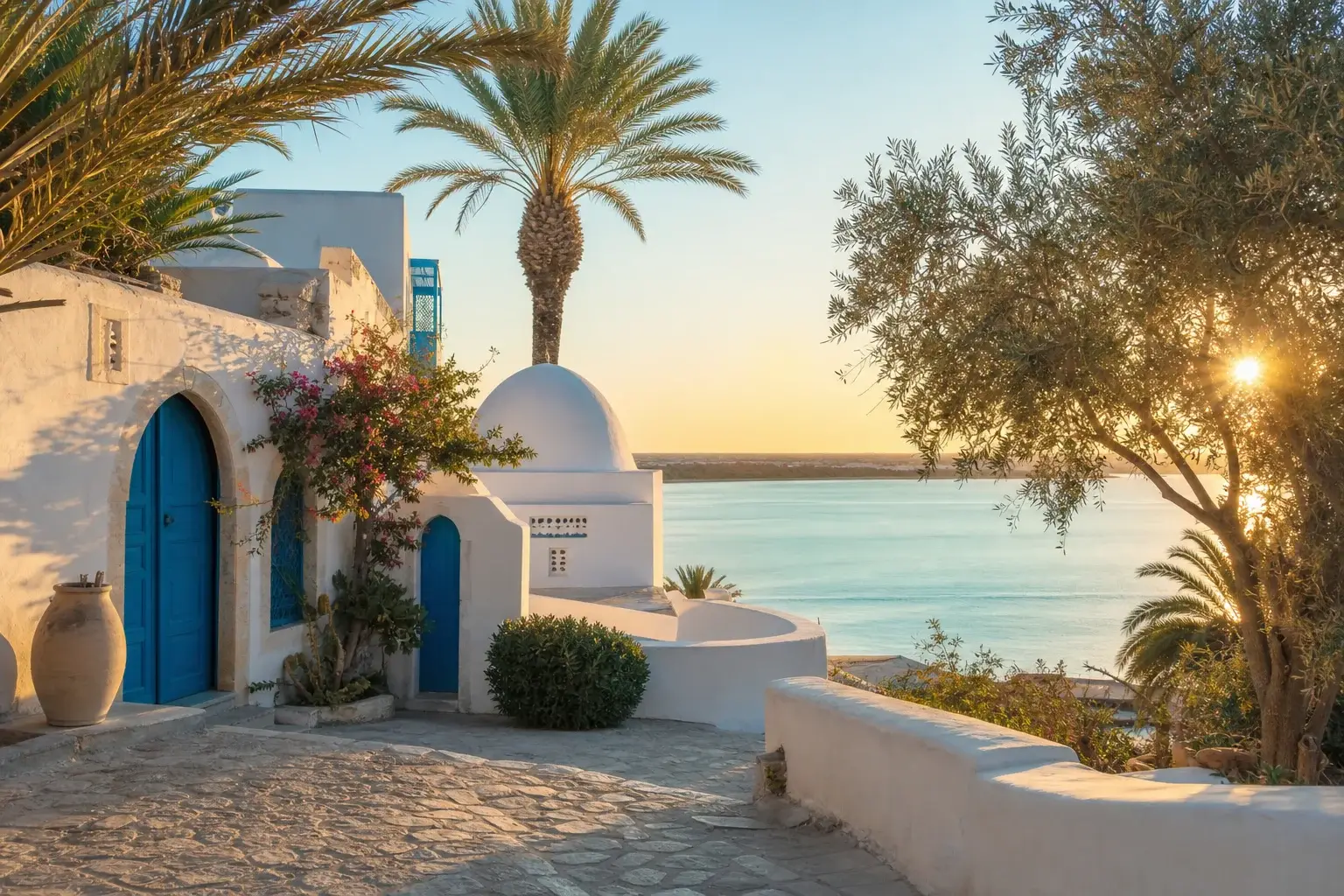
Sidi Bou Said will always be photographed. Carthage will always be explained. The question for 2060 is what happens after the postcard — when a traveller wants a country rather than a caption.
Beyond the classics, Tunisia offers sequences: a morning in the medina of Sousse, an afternoon among the brick geometry of Tozeur, a night at the edge of Douz where the dunes become architecture. Djerba is not a beach. It is an island of white volumes, olive groves and a pace that refuses urgency.
The best new journeys are designed like products. Transfer, hotel, walk, meal, silence. Nothing is left to a laminated itinerary. The guest arrives knowing the coordinates and still has room to get lost.
It is an island of white volumes, olive groves and a pace that refuses urgency.
Digital platforms made this possible. They also made it fragile. A country cannot be reduced to a grid of available cars. The operators who will last are the ones who still know the road when the signal does not.
To discover Tunisia now is to accept that heritage and the future are not opposites. They are the same landscape, seen at two distances.
Sara El Mekki